AAC Devices: Augmentative and Alternative Communication
The American Speech-Language-Hearing Association (ASHA) describes an AAC as “all of the ways someone communicates besides talking.” People of all ages can use an AAC if they have trouble with speech or expressive language skills. AAC is helpful for, but not limited to, apraxia of speech or childhood apraxia of speech (CAS), autism, and other speech/language delays. These are communication devices or “talkers.” There are multiple levels of AAC.
Our Speech-Language Pathologist evaluates the patient and programs the AAC for our patients to start learning on/using.
A few of our students use these tools to help with their everyday activities.
- AUGMENTATIVE: Adds to someone’s speech.
- ALTERNATIVE: Used instead of speech or alongside speech.
Some individuals use an AAC their entire life, while others may use it as a stepping stone for their next voice journey. It is a fallacy that people who use AAC will not promote speech.
Types of AAC:
“No-Tech” and “Low-Tech” Options:
These options do not require much technology at all.
- Gestures/facial expressions
- Writing
- Drawing
- Spelling words by pointing to letters/photos
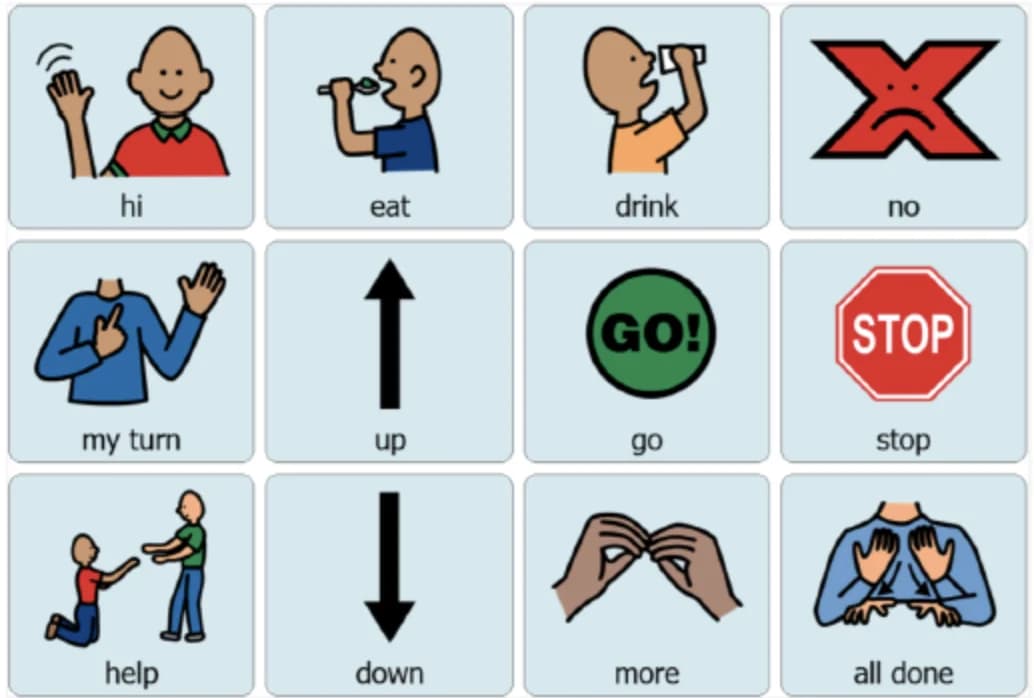
- AAC Board (Pictured Below)
“High-Tech” Options:
These devices do require some technology. They are used to speak a message out loud for the person after they push a button.
- Using an app to communicate
- Using a device/tablet to generate speech/voice

For more information, please visit the following resources:
- https://www.asha.org/public/speech/disorders/aac/
- https://www.asha.org/practice-portal/professional-issues/augmentative-and-alternative-communication/
If you have any further questions or require more assistance, please reach out to us.